Birdsong field guide
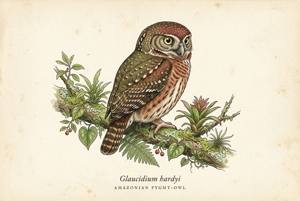
Amazonian Pygmy-Owl
Glaucidium hardyi
A diminutive, canopy-dwelling owl of the Amazon Basin, recognized for its daytime activity and distinctive 'false eyes' on its nape.
What it sounds like
A rapid, high-pitched series of 10–30 short, hollow whistles that accelerate slightly, sounding like 'hu-hu-hu-hu-hu'.
Reference call, compare with what you heard
0:00 / 1:03
Field notes
- It is one of the smallest owls in the world, typically measuring only 14 to 15 centimeters in total length.
- The species possesses prominent black 'ocelli' on the back of its head, which mimic eyes to deter predators and confuse mobbing songbirds.
- First formally described by science in 1989, it was long overlooked due to its habitat in the high rainforest canopy.
- Unlike many owls, it is primarily diurnal and crepuscular, often seen perched and hunting during the heat of the day.
- Despite its tiny size, it is a formidable predator capable of taking down large insects and small vertebrates like lizards.
Habitat
Humid lowland rainforest, specifically restricted to the canopy and sub-canopy layers.
Range
Amazon Basin of South America, spanning Brazil, Peru, Bolivia, Ecuador, Colombia, Venezuela, and the Guianas.
Similar & commonly confused birds
African Barred OwletGlaucidium capenseAlbertine OwletGlaucidium albertinumAndean Pygmy-OwlGlaucidium jardiniiAsian Barred OwletGlaucidium cuculoidesAustral Pygmy-OwlGlaucidium nanaCentral American Pygmy-OwlGlaucidium griseicepsChestnut-backed OwletGlaucidium castanotumCloud-forest Pygmy-OwlGlaucidium nubicola
Heard a Amazonian Pygmy-Owl?
Open Birdsong, tap record, and identify the bird singing near you in seconds — then collect it in your field journal.
Identify a bird by its song