Birdsong Feldführer
Amazonasseeschwalbe
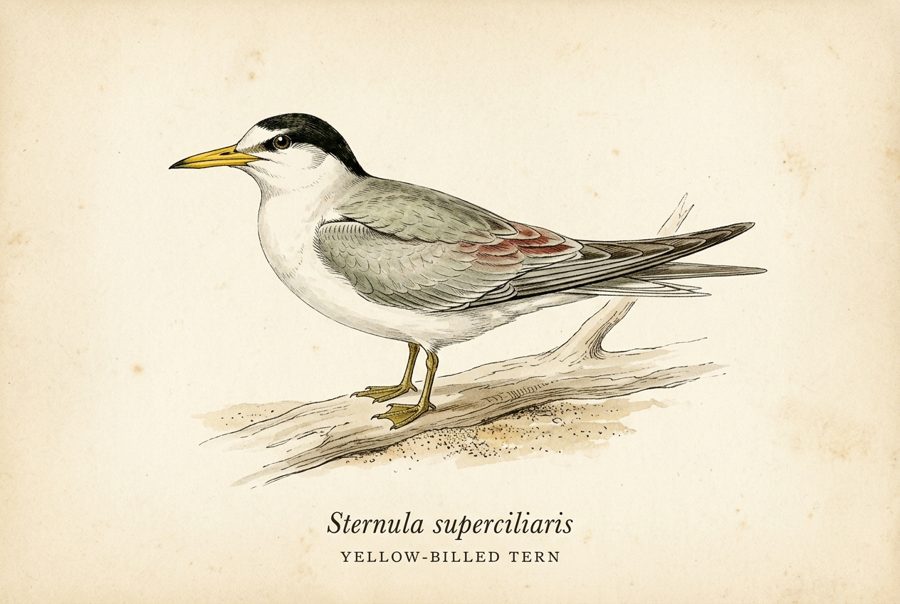
Sternula superciliaris
A small, freshwater-dwelling tern of South America characterized by its stout yellow bill and pale gray plumage.
Wie er klingt
A sharp, metallic 'kwee-it' or a repetitive, high-pitched 'kip-kip-kip'.
Referenzruf, vergleiche ihn mit deiner Beobachtung
0:00 / 0:16
Feldnotizen
- It is the smallest species of tern native to the South American continent.
- Unlike many terns, it is primarily a freshwater species, often found thousands of kilometers inland along major river systems.
- Breeding is timed to the dry season to take advantage of emerging sandbars for nesting sites.
- It is distinguished from the similar Least Tern by its larger, entirely yellow bill that lacks a black tip.
- Foraging involves high-altitude hovering followed by a vertical plunge-dive to capture small fish and crustaceans.
Lebensraum
Large lowland rivers, freshwater lakes, and marshes with exposed sandbars.
Verbreitung
South America, east of the Andes, ranging from Colombia to northern Argentina.
Häufige Fragen
Wie klingt ein Amazonasseeschwalbe?+
A sharp, metallic 'kwee-it' or a repetitive, high-pitched 'kip-kip-kip'.
Wie erkennt man einen Amazonasseeschwalbe?+
A small, freshwater-dwelling tern of South America characterized by its stout yellow bill and pale gray plumage.
Wo lebt der Amazonasseeschwalbe?+
Large lowland rivers, freshwater lakes, and marshes with exposed sandbars. South America, east of the Andes, ranging from Colombia to northern Argentina.
Ähnliche & oft verwechselte Vögel
Einen Amazonasseeschwalbe gehört?
Öffne Birdsong, tippe auf Aufnahme und bestimme Vögel in deiner Nähe in Sekunden – und sammle sie in deinem Tagebuch.
Vogel am Gesang bestimmen