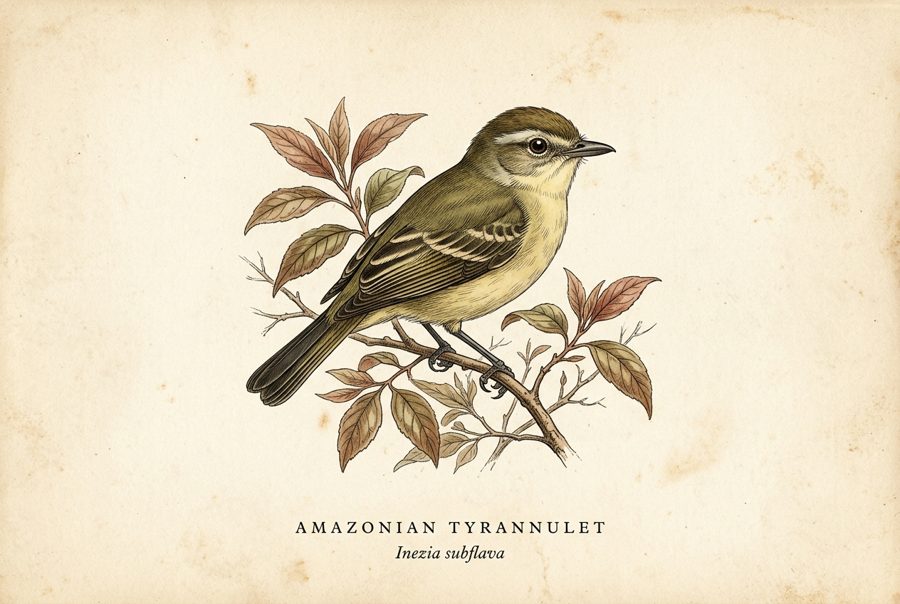
Amazonian Tyrannulet
A small, active flycatcher of the Amazon and Orinoco basins, characterized by its olive-drab plumage and preference for riparian scrub. It is easily identified by its pale spectacles and restless foraging behavior.
What it sounds like
A thin, high-pitched and rhythmic series of 'twee-twee-twee' notes, often ending in a dry rattle.
Field notes
- Displays a distinct facial pattern consisting of a white loral spot and a thin, broken eye-ring.
- Unlike many other tyrannulets, it frequently pumps or cocks its tail while moving through low vegetation.
- Specifically favors early-successional habitats such as those found on river islands.
- Primarily insectivorous, utilizing hover-gleaning and quick sallies to capture prey from foliage.
- Is a member of the genus Inezia, which contains four species of South American scrub-flycatchers.
Common questions
What does a Amazonian Tyrannulet sound like?+
A thin, high-pitched and rhythmic series of 'twee-twee-twee' notes, often ending in a dry rattle.
How do you identify a Amazonian Tyrannulet?+
A small, active flycatcher of the Amazon and Orinoco basins, characterized by its olive-drab plumage and preference for riparian scrub. It is easily identified by its pale spectacles and restless foraging behavior.
Where does the Amazonian Tyrannulet live?+
River island thickets, riparian scrub, and edges of seasonally flooded várzea forest. Tropical South America, spanning the Amazon and Orinoco basins in Brazil, Colombia, and Venezuela.
Similar & commonly confused birds
Open Birdsong, tap record, and identify the bird singing near you in seconds, then collect it in your field journal.
Identify a bird by its song