Birdsong field guide
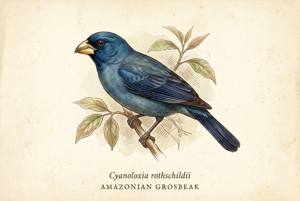
Amazonian Grosbeak
Cyanoloxia rothschildii
A robust, large-billed forest finch of the Amazon Basin, recognized by the male's deep midnight-blue plumage and the female's rich tawny-brown coloration.
What it sounds like
A series of rich, liquid, and melodic whistled phrases; the contact call is a sharp, metallic 'pink' or 'pik'.
Reference call, compare with what you heard
0:00 / --:--
Field notes
- Formerly classified as a subspecies of the Blue-black Grosbeak before being elevated to full species status based on vocal and plumage differences.
- Features a massive, swollen black bill specifically adapted for crushing hard tropical seeds.
- Despite their striking color, they are often difficult to spot as they prefer the dense, shaded understory of primary forests.
- The species is sexually dimorphic, with females sporting a completely different cinnamon-brown plumage to provide camouflage while nesting.
- It typically forages alone or in pairs, rarely joining mixed-species flocks that move through the forest mid-story.
Habitat
Humid lowland evergreen forest, mature secondary growth, and dense forest edges.
Range
The Amazon Basin of South America, spanning across Brazil, Peru, Ecuador, Colombia, Bolivia, and the Guianas.
Similar & commonly confused birds
Heard a Amazonian Grosbeak?
Open Birdsong, tap record, and identify the bird singing near you in seconds — then collect it in your field journal.
Identify a bird by its song