Birdsong field guide
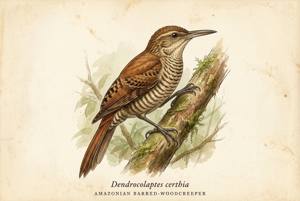
Amazonian Barred-Woodcreeper
Dendrocolaptes certhia
A large, robust woodcreeper easily identified by the dense, dark horizontal barring across its entire head, body, and underparts.
What it sounds like
A loud, descending series of clear, musical whistles, often transcribed as 'peee-peee-peee-peu-peu-pu'.
Reference call, compare with what you heard
0:00 / --:--
Field notes
- It is a specialized 'obligate' or regular follower of army ant swarms, waiting on trunks to snatch prey flushed by the ants.
- Unlike many related species, its diet often includes small vertebrates such as lizards and frogs in addition to large arthropods.
- The species uses its stiff, spine-tipped rectrices (tail feathers) as a tripod-like prop to support its weight while climbing vertically.
- Its heavy, straight bill is typically dusky or bicolored, distinguishing it from the red-billed woodcreepers often found in the same range.
- It is a cavity nester, typically laying two white eggs in natural tree hollows or abandoned woodpecker holes located 1 to 6 meters high.
Habitat
Humid lowland evergreen forests, primarily terra firme and occasionally transitional or floodplain forests.
Range
Widespread across the Amazon Basin, including parts of Brazil, Peru, Colombia, Ecuador, Bolivia, and the Guianas.
Similar & commonly confused birds
Heard a Amazonian Barred-Woodcreeper?
Open Birdsong, tap record, and identify the bird singing near you in seconds — then collect it in your field journal.
Identify a bird by its song